
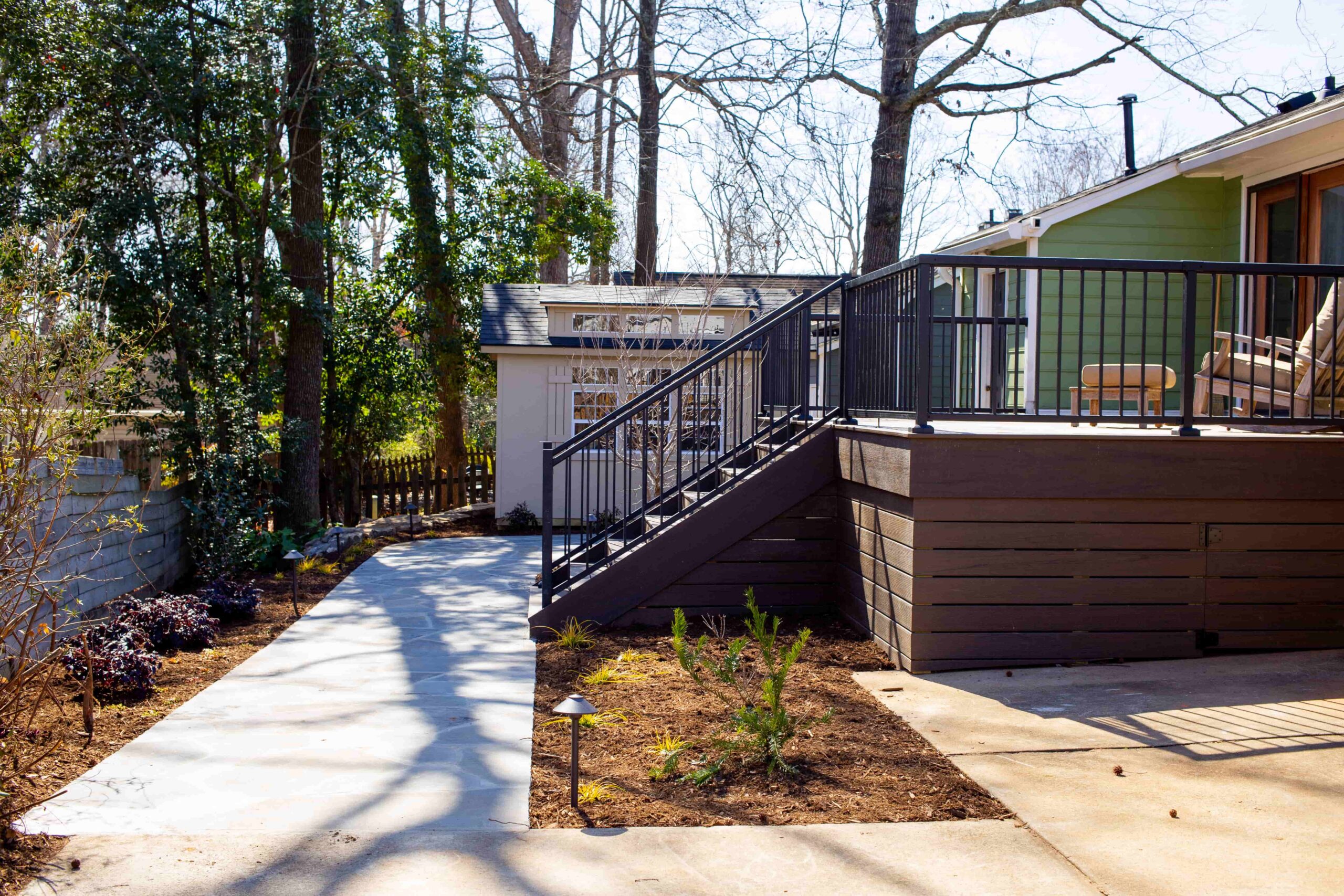
Key Points:
- Premium composite decking from Trex and Azek/TimberTech is engineered with a protective outer layer that resists fading, staining, and weathering. Natural wood, by contrast, grays, cracks, and eventually decays as sun and moisture work on it year after year.
- Reedy River Landscapes builds with the best composite decking materials available and helps each client choose the line, color, and finish that suits the home and the site.
- Because composite boards never need sanding, staining, or sealing, a properly designed and installed deck can hold its appearance for 30 years or more with little more than routine cleaning.
A deck is one of the few parts of a home expected to look good while standing in direct sun, absorbing rain, and supporting furniture, foot traffic, and the occasional spilled glass of wine. How well it meets that expectation depends on two things: the design and the materials used to construct it.
For a long time, the default deck material was natural wood. For that reason, homeowners have accepted the recurring cycle of washing, sanding, staining, and sealing that wood requires.
Engineered decking has changed that equation. Reedy River Landscapes designs and builds custom composite decks with Trex and Azek/TimberTech materials because both resist fading, staining, and weathering in ways natural wood simply cannot.
The information below explains the science behind that difference, how composite compares to other common decking materials, and what homeowners should consider when planning a deck as part of a larger outdoor living space.
How Sun and Moisture Break Down a Wood Deck
We have used wood for so long that we have learned to design around the knowledge that it changes dimensions in distinct conditions, like moisture content. Likewise, wood is susceptible to degradation by a wide variety of organisms, from fungi and bacteria to termites, ants, carpenter bees, and more.1
On an exposed deck, three forces of nature do most of the damage:
- Ultraviolet light: Sunlight breaks down the compounds that bind wood fibers together at the surface. Over time, unfinished boards lose their original color, turn a weathered silver-gray, and slowly erode as loosened fibers wash away.2
- Moisture cycling: Deck boards absorb water during rain and then dry rapidly in the sun. When this happens, the top surface of a decking board often becomes much drier than the rest of the board, and the resulting uneven shrinkage causes “cupping” (boards curling at the edges) and “checking” (small cracks running along the grain).3
- Decay and insects: Wherever wood stays damp in shaded corners, near the ground, or beneath collected leaves, fungi can take hold. Wood-boring insects add a further risk in warm climates.
Stains and sealers can help slow these processes, but they do not cease them altogether. A wood deck kept in good condition requires regular cleaning, periodic sanding to remove splinters and raised grain, and fresh coats of finish on a recurring schedule. Once that maintenance lapses, deterioration tends to accelerate.
How Trex and TimberTech Boards Are Built
Modern composite decks are not simply plastic shaped to resemble wood. Premium boards are engineered in layers: a dense core provides strength and stiffness, while a protective outer “cap” or “shell” faces the weather. This capping is the most important development in composite decking in recent decades, and it is the main reason today’s boards perform so differently from early composite products.
Both manufacturers Reedy River Landscapes works with take this layered approach, though in different ways:
- Trex: Trex’s high-performance boards combine recycled plastic film and reclaimed wood fibers in a composite core, then wrap the board in a protective shell on three sides. Trex introduced this shell technology in 2010 specifically to address the fading, staining, and mold problems that affected early-generation wood-plastic composites across the industry.4
- Azek/TimberTech: TimberTech offers capped composite collections as well as its premium Advanced PVC decking (the line long sold under the AZEK name). Advanced PVC boards are completely synthetic (a capped polymer with no wood content), which makes them especially resistant to moisture, mold, and rot. This makes them a strong choice for around pools.6
In both cases, the protective layer is what meets the sun, the rain, and the spills, while the core beneath supplies structure without direct exposure to the elements.
Resistance to Fading, Staining, and Weathering
These three properties are where composite decks most clearly outperform natural wood, and they are the central reason Reedy River Landscapes builds with Trex and TimberTech. Here is how each one plays out over the life of a deck:
- Fade resistance: The protective cap is formulated to hold its color under prolonged sun exposure. Some subtle color change can still occur as part of normal weathering, but capped boards are designed to retain their appearance for decades rather than graying the way unfinished wood does. Both manufacturers back their premium lines with fade and stain warranties that extend for decades.
- Stain resistance: Because wood is porous, spilled wine, grease from a grill, and tannins from fallen leaves can soak in and leave lasting marks. The dense surface of a capped board keeps most of these substances on top, where soap and water can remove them.
- Weather resistance: Capped composite and PVC boards do not absorb water the way wood does, so they resist the swelling, cupping, cracking, and splintering that come with repeated wet and dry cycles. They also resist rot and insect damage, two of the most common reasons wood decks are replaced.
The result is a deck that never needs sanding, staining, or sealing. Routine care consists of sweeping away debris and washing the surface periodically. This is a far smaller commitment than the recurring refinishing a wood deck requires.
Why the Upstate Climate Favors Composite Decking
Greenville, SC, and the surrounding Upstate, is a demanding environment for any outdoor structure. Long, humid summers keep wood damp for extended periods, afternoon thunderstorms soak decks before giving way to intense sun, and winter brings periodic freezes. The mature hardwood canopies found in many established Greenville neighborhoods add shade that slows drying, along with a steady supply of leaves, pine needles, pollen, and tannins that discolor porous surfaces.
These conditions accelerate every form of wood deterioration described above. They are also precisely the conditions Trex and TimberTech products are engineered to withstand, which is why many experienced landscapers in Greenville, SC, recommend capped composite and PVC decking to clients who want an outdoor space that looks as good in its fifteenth summer as it did in its first.
The same reasoning applies for Reedy River Landscapes’ clients in Asheville, NC, where mountain weather brings its own mix of moisture and temperature swings. Our decking materials are made to hold up well against snow, sleet, and freezing temperatures.
Designing the Deck as Part of the Landscape
A deck performs best, visually and functionally, when it is planned as part of the entire property, as opposed to a standalone addition. When it comes to landscape design, Greenville, SC, homeowners often want a deck that connects seamlessly with patios, plantings, lighting, and outdoor kitchens.
Site conditions matter just as much. In landscape architecture, Greenville’s rolling topography shapes many projects from the start. Sloped lots may call for multi-level decks, integrated stairs, or retaining walls. And the deck’s placement affects views, shade, drainage, and how people move between the house and the yard. For that reason, when evaluating landscaping companies, Greenville, SC, residents will benefit from asking how a new deck will be integrated into the rest of the property, not just how it will be built.
Reedy River Landscapes begins every deck project with an in-person visit. From there, the work moves through three main stages:
- Consultation and design: Goals, preferred materials, and design inspiration are discussed so the plan fits both the space and the budget.
- Material selection and planning: The appropriate Trex or TimberTech line, color, and finish are finalized, along with details such as hidden fasteners, borders, and railings, so clients know exactly what to expect before construction begins.
- Professional installation: Skilled builders handle every detail from the foundation to the finishing touches. Even the most durable decking board depends on sound framing beneath it, so structural work receives the same attention as the visible surface.
- This integrated approach allows a new deck to connect naturally with the company’s other services, including:
Start Your Composite Deck Project Today
A deck should be a place to relax, not a recurring maintenance project. By building with Trex and Azek/TimberTech composite decking, Reedy River Landscapes gives clients in Greenville, SC, and Asheville, NC, an outdoor space that resists fading, staining, and weathering for decades.
Homeowners searching for landscaping companies in Greenville, SC, that can design and build a composite deck as part of a complete outdoor living space are invited to contact Reedy River Landscapes to schedule a consultation. Because availability can book out months in advance, reaching out early is the surest way to have a new deck ready for the next outdoor season.
Frequently Asked Questions
Is composite decking completely maintenance-free?
Not quite. Trex and TimberTech decking never needs sanding, staining, or sealing, but it does benefit from occasional sweeping and a periodic wash with soap and water to remove dirt, pollen, and leaf debris. Keeping the gaps between boards clear also helps water drain freely and discourages mildew from forming on surface grime.
Does composite decking get hot in the summer?
It can. Composite and PVC boards absorb heat in direct sun, and darker colors run noticeably warmer than lighter ones. Both manufacturers offer heat-mitigating lines, and choosing a lighter color or adding shade from a pergola or nearby trees can make a huge difference on decks with a lot of sun exposure.
How long does a composite deck last?
With proper installation and minimal upkeep, a Trex or TimberTech deck can last 30 years or more, maintaining its appearance and structural integrity far longer than a typical wood deck. Both manufacturers support their premium lines with long-term product warranties and fade and stain warranties that span decades.
Is composite decking worth the higher upfront cost?
For homeowners who plan to enjoy their deck for many years, the answer is most often yes. Composite decking costs more to purchase and install than pressure-treated pine, but it eliminates the recurring expense of cleaners, stains, sealers, and replacement boards, along with the time those projects require. Over the life of the deck, the difference in total cost narrows considerably, while the difference in appearance tends to widen.
References
- Lauritz Schrader, Christian Brischke, Jochen Trautner, and Christoph C. Tebbe, “Microbial decay of wooden structures: actors, activities and means of protection,” Applied Microbiology and Biotechnology, March 2025, https://pmc.ncbi.nlm.nih.gov/articles/PMC11882669/.
- A. L. Andrady, A. M. Heikkilä, K. K. Pandey, et al., “Effects of UV radiation on natural and synthetic materials,” Photochemistry and Photobiology, April 2023, https://pmc.ncbi.nlm.nih.gov/articles/PMC10088630/
- R. Sam Williams, “Finishing of Wood,” USDA Forest Service, Forest Products Laboratory, April 2010. https://www.fpl.fs.usda.gov/documnts/fplgtr/fplgtr190/chapter_16.pdf
- “Trex Composite Decking and Railing FAQs,” Trex, May 2026, https://www.trex.com/why-trex/faq/.
- “TimberTech Advanced PVC Decking Overview,” TimberTech, July 2026, https://www.timbertech.com/products/decking-overview/pvc/.

Luke founded the company in 2016 and has loved growing the business ever since. He’s passionate about helping our leaders develop and seeing people reach their full potential—it’s one of his favorite parts of the job. Luke enjoys meeting new people and transforming their goals and challenges into beautiful, functional outdoor living spaces. When he’s not working, you’ll often find him spending quality time with his family around the community—whether that’s at the farmers market, CrossFit, or enjoying any kind of outdoor activity.

